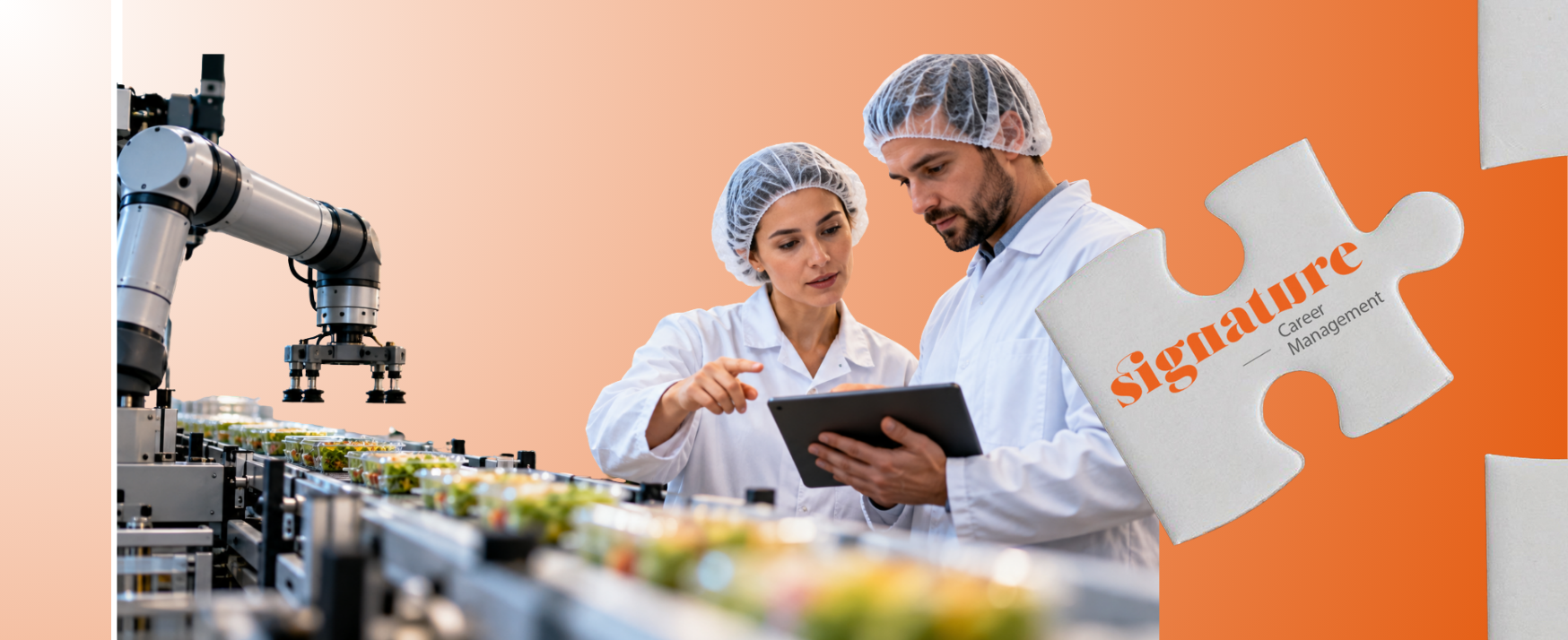
Automation Doesn't Remove the People Problem in FMCG. It Changes It.
We recently came across a story about a major FMCG manufacturer investing millions in new technology and automation.
Nothing particularly unusual there. Investment in AI, automation and technology is becoming an increasingly familiar part of the conversation across FMCG, but one detail caught our attention.
Alongside investing in technology designed to automate more of its operations, the business was also talking about creating more skilled roles to work alongside it. You can read the story that got us thinking here: : Avara Foods to invest £10m into Telford site.
And it raises an interesting question about the future of talent in FMCG. Because perhaps when businesses automate, the question isn't simply: "How many people will we need?" it becomes, "What will we need those people to be capable of?"
Automation changes the work
Much of the conversation around AI and automation still centres on whether technology will replace jobs. In reality, the picture is more complicated.
Yes, some tasks will disappear. Some processes will require fewer people. And some roles will inevitably change significantly. But removing a task isn't necessarily the same as removing the need for a person. Often, technology changes where human value sits.
A process that once required someone to carry out a repetitive task may instead require someone who can manage the technology, interpret its output, identify problems, improve the process or make decisions using the information it provides.
And this isn't just happening on the factory floor.
Think about what's already changing across FMCG.
AI can analyse huge quantities of data. Automation can remove administrative tasks. Technology can improve forecasting. Systems can provide commercial teams with increasingly sophisticated information about customers, consumers, pricing and performance. But somebody still needs to decide what to do with it.
The skills around the technology become more important
That's where we think the people conversation gets interesting.
If technology can increasingly handle the repeatable elements of a role, the skills that sit around those tasks potentially become more valuable:
Commercial judgement.
Problem-solving.
Adaptability.
Creativity.
Relationship-building.
Data literacy.
The ability to interpret information and turn it into action. And, increasingly, the ability to understand how technology can be used effectively rather than simply knowing how to complete a process manually.
For FMCG businesses, that means investment in technology can't sit completely separately from workforce planning. If your business is going to operate differently in three years' time, there's a good chance your people will need to operate differently too.
So, do you upskill or hire?
That's perhaps one of the most interesting questions for businesses investing in automation and AI.
In many cases, developing existing employees will be the right answer. Those people already understand your products, customers, culture and business. Giving them the skills to operate in a more technology-enabled environment can retain valuable knowledge while creating opportunities for progression. But upskilling can't solve every capability gap. Sometimes a business is moving into an area where the knowledge or experience simply doesn't exist internally yet. That's when recruitment becomes less about replacing somebody who's left and more about bringing a capability into the organisation that wasn't there before.
And we think that's an important distinction for FMCG recruitment. Workforce planning has traditionally involved looking at headcount, succession, expected vacancies and growth plans. Whilst those things still matter, perhaps another question needs to become much more prominent:
"What will our business need to be capable of doing in the future that it can't do today?"
Once you know the answer, you can start working backwards and asking:
What skills will that require?
Which already exist within the business?
Which can realistically be developed?
And which might need to come from somewhere else?
It might also change who the 'right' candidate is
There's another implication for recruitment. If roles are changing, hiring businesses can't necessarily continue recruiting against the same profile they've always looked for.
The strongest candidate for the next five years might not look exactly like the strongest candidate from the previous five. Someone may have worked in a slightly different sector, and their previous job title might not perfectly match yours. They may have less experience in one particular area but significantly more exposure to technology, data or transformation. Or they may simply demonstrate the adaptability and learning agility required to grow as the role changes.
That requires businesses to be really clear about what they actually need someone to achieve, rather than simply creating a checklist based on the person who previously held the role.
It's something we think matters particularly when recruiting within FMCG. Our approach at Signature is built around understanding a business, its culture, ambitions and challenges before searching the market, because the right hire isn't simply the CV containing the greatest number of matching keywords.
Automation doesn't make people less important
Technology will continue to change FMCG. Some jobs will change. Some tasks will disappear. New roles will emerge, and existing roles will require different skills. But that doesn't necessarily make the people question smaller. It just makes it different.
And that's why, when businesses are discussing investment in AI, automation and technology, we think there should be a people conversation happening alongside it.
Not simply:
"How many people will this save us?"
But:
"What will this change about the people we need?"
Because investing in technology without considering the capability required around it risks solving only half the problem.
Automation doesn't remove the people problem. It changes it.
And the businesses thinking about that now will be much better placed to build the FMCG teams they'll need next.
If you're thinking of recruiting into your commercial team and want a second opinion on your role brief, we would be happy to give you our thoughts.